

BISP New Announcement 2026
The Benazir Income Support Programme continues to play a vital role in reducing poverty and supporting vulnerable families across Pakistan. In 2026, the government has made a new announcement regarding the BISP 8171 payment and registration process, bringing important updates for existing beneficiaries as well as new applicants. This announcement focuses on improved transparency, faster payment distribution, and easier access to registration and verification services.
Also Read:NADRA Introduces Facial Recognition Biometric System to End Fingerprint Verification Issues
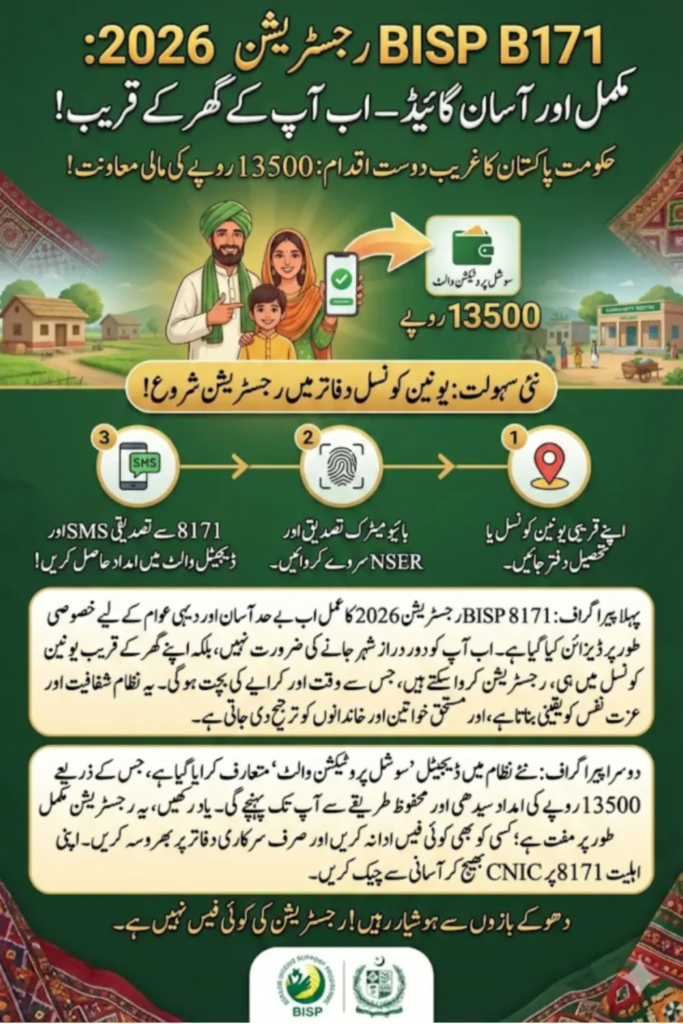
The latest updates aim to ensure that financial assistance reaches deserving families on time, especially women-led households that rely heavily on BISP support for basic needs such as food, healthcare, and education.
Overview of BISP New Announcement 2026
The Benazir Income Support Programme (BISP) continues to provide financial support to low-income and vulnerable families across Pakistan. In 2026, the government introduced an important update for the 8171 payment and registration system. This announcement focuses on improving transparency, speeding up payments, and making registration easier for both existing and new applicants. Families are encouraged to verify their CNIC information to remain eligible for support.
8171 Payment Update
Under the new 2026 update, BISP payments will continue to be distributed through the 8171 system. Eligible families can receive their installments at designated payment centers, partner banks, or through digital payment options where available. Beneficiaries are advised to check their payment status using the 8171 SMS service or the official online portal before visiting payment centers. The amount of payment may vary according to government policy, but the focus remains on providing meaningful financial relief to deserving households.
Registration and CNIC Verification
The announcement emphasizes accurate registration and re-registration for all applicants. Families who were previously ineligible or missed earlier surveys should update their records. CNIC verification is a critical step in ensuring eligibility. Any mismatch between NADRA and BISP records can delay payments or lead to disqualification. Applicants can check their eligibility via SMS or the official BISP web portal. Accurate data collection ensures that funds reach the right beneficiaries efficiently.
Importance of Digital Payments and Transparency
The 2026 update strengthens transparency in the BISP system by using digital payment methods. Direct transfers to bank accounts reduce the risk of corruption and minimize human intervention. Beneficiaries are encouraged to follow official channels and avoid unofficial agents who claim to offer faster approvals. This modernization ensures fair distribution of funds and builds trust in the social welfare system.
Overview of the BISP New Announcement 2026
The BISP New Announcement 2026 highlights changes in payment schedules, eligibility verification, and registration procedures under the 8171 system. The government has emphasized digitization and data accuracy to eliminate delays and reduce ineligible entries. Beneficiaries are encouraged to verify their CNIC information regularly to remain eligible for payments.
This announcement also reaffirms the government’s commitment to social protection by expanding coverage and ensuring fair distribution of funds through digital channels.
8171 Payment Update for 2026
Under the new announcement, BISP payments for 2026 will continue to be distributed through the 8171 system. Eligible families will receive their installments through designated payment centers, partner banks, or digital payment solutions where available.
The payment amount may vary based on policy decisions, but the focus remains on providing meaningful financial relief. Beneficiaries are advised to check their payment status using the 8171 SMS service or the official online portal before visiting payment centers to avoid inconvenience.
Registration and Re-Registration Process
The 2026 update places strong emphasis on registration and re-registration. Families who were previously ineligible or missed earlier surveys are being encouraged to update their information. New applicants must ensure that their household data is accurate and complete.
Registration is linked with the NSER survey, which assesses household poverty levels using the PMT score system. Applicants with incomplete or outdated records may be required to visit designated registration centers for data verification.
Also Read:Punjab Intermediate Annual Exams 2026 Complete Guides & Details
CNIC Verification Through 8171
CNIC verification remains a critical part of the BISP system. Under the new announcement, beneficiaries must ensure that their CNIC is valid and active. Any mismatch between NADRA records and BISP data can result in payment delays or disqualification.
The 8171 system allows applicants to check their eligibility by sending their CNIC number via SMS or through the official web portal. This simple verification step helps beneficiaries stay informed about their payment status.
Eligibility Criteria Under the New Update
The eligibility criteria under BISP 2026 remain focused on low-income and vulnerable households. Priority is given to widows, women-headed households, persons with disabilities, and families living below the poverty threshold.
Applicants must not hold government employment, own significant property, or have high bank balances. The updated system ensures that only deserving families receive assistance by cross-checking data with multiple government databases.
Importance of Digital Payments and Transparency
One of the major goals of the new BISP announcement is transparency. Digital payment systems reduce the risk of corruption and ensure that funds are transferred directly to beneficiaries. This approach minimizes human intervention and increases trust in the system.
Beneficiaries are encouraged to follow official channels for information and avoid agents or unauthorized individuals who claim to offer fast approvals.
Common Issues Faced by Beneficiaries
Despite improvements, some beneficiaries may still face issues such as delayed payments, incorrect eligibility status, or missing records. These issues are often caused by outdated CNIC information, incomplete surveys, or technical delays.
The government advises beneficiaries to regularly check updates, respond to verification messages, and visit official BISP centers if required. Timely action can prevent long-term disqualification.
Government’s Vision for BISP in 2026
The 2026 announcement reflects a broader vision of strengthening social safety nets in Pakistan. By integrating technology, improving data accuracy, and expanding outreach, the government aims to support millions of families more effectively.
The focus is not only on financial assistance but also on empowering beneficiaries through better access to services and information.
Frequently Asked Questions
Who is eligible for BISP under the 2026 announcement?
Low-income and vulnerable families meeting the poverty criteria are eligible.
How can I check my BISP 8171 payment status?
You can check your status via the 8171 SMS service or the official online portal.
Is new registration open for BISP 2026?
Yes, new registration and data updates are available through designated centers.
What should I do if my CNIC verification fails?
You should update your CNIC details with NADRA and recheck through 8171.
How are BISP payments distributed in 2026?
Payments are distributed through banks, payment centers, and digital methods.
Also Read:Diamer BISP Beneficiaries Notice: Wallet Account Verification Mandatory for Jan–March Payment
Conclusion
The BISP New Announcement 2026 brings important improvements to the 8171 payment and registration system, focusing on transparency, efficiency, and inclusion. By encouraging CNIC verification, digital payments, and accurate data collection, the government aims to ensure that financial assistance reaches those who truly need it. Beneficiaries are advised to stay informed through official channels, keep their records updated, and follow the proper procedures to continue receiving support. This initiative remains a cornerstone of Pakistan’s efforts to reduce poverty and support vulnerable communities.