

Pakistan Government Work-From-Home Policy
The federal government of Pakistan has announced new austerity measures to tackle economic strain and rising fuel shortages linked to the Middle East conflict. Prime Minister Muhammad Shehbaz Sharif unveiled policies including a work-from-home plan, a four-day work week, and strict fuel rationing for public institutions. These measures aim to reduce costs, save fuel, and promote online communication to maintain government functions efficiently.
Officials stated that these steps are temporary but critical to reduce unnecessary spending and fuel use. The government is also emphasizing accountability, online communication, and transparency in all departments to improve efficiency during this period.
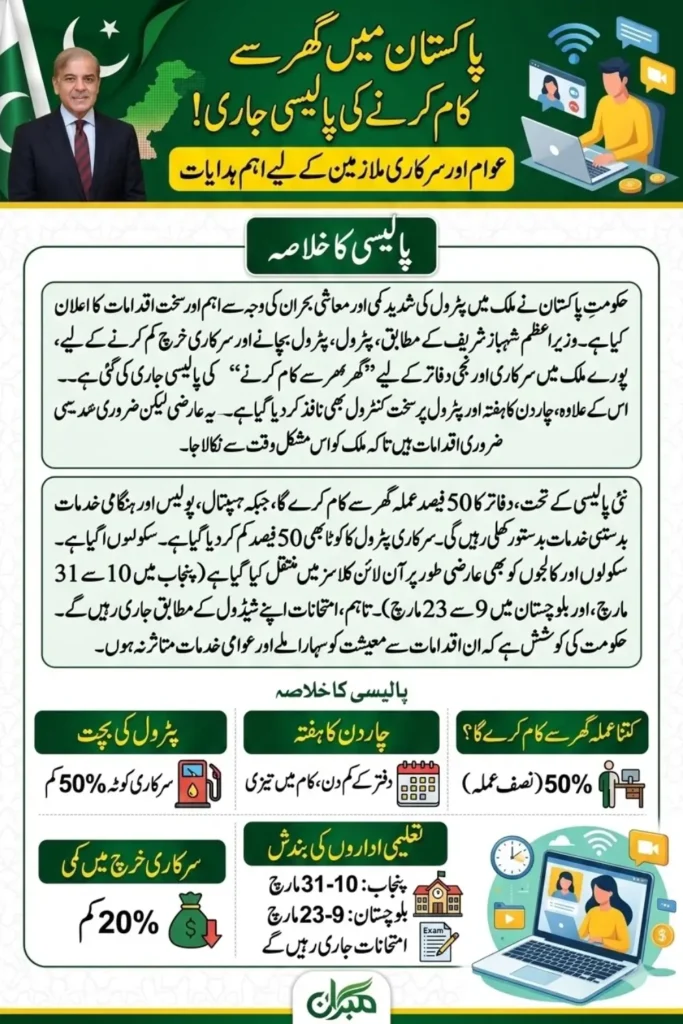
Work-From-Home Policy Pakistan
The new work-from-home policy allows 50% of employees in public and private institutions to work remotely. Essential services such as healthcare, emergency response, and law enforcement are excluded. The initiative encourages employees to attend online meetings, reducing travel and fuel consumption.
Key points of the policy include:
- 50% staff in public and private offices to work from home.
- Use of video-link communication for official meetings.
- Exceptions for essential services.
This measure ensures continuity of government operations while limiting commuting. It is part of a broader strategy to manage fuel demand and reduce operational costs for institutions across the country.
Pakistan 5G Spectrum Auction 2026: Key Details, Benefits, and Telecom Sector Updates
Four-Day Work Week for Public and Private Sector
The government has introduced a four-day work week to further conserve fuel and reduce expenses. Banks, industries, and agriculture sectors are exempt and will maintain regular schedules. The reduced working days aim to minimize operational costs without affecting essential services.
Benefits and highlights include:
- Less fuel usage due to fewer commuting days.
- Increased focus on productivity during office hours.
- Alignment with austerity measures to cut public expenditure.
The four-day schedule is expected to be implemented immediately and monitored for efficiency. It complements the work-from-home plan to optimize staff allocation and office resource usage.
Fuel and Transport Restrictions
The federal government has imposed strict fuel and transport limits to save resources. Public sector fuel quotas will be reduced by 50% for two months, with exceptions for ambulances and public transport vehicles. Government offices are required to shut down 60% of their vehicle fleet temporarily.
Key actions include:
- 50% reduction in fuel quotas for two months.
- 60% government transport temporarily off-road.
- Only essential vehicles remain operational.
These measures aim to reduce energy costs while maintaining critical services. By limiting travel and fuel use, the government expects savings that will help manage the ongoing economic pressure.
| Restriction | Duration | Exemptions |
|---|---|---|
| Fuel quota reduction | 2 months | Ambulances, public buses |
| Government transport shutdown | 2 months | Essential office vehicles |
Spending and Procurement Cuts
To further enforce austerity, the government has ordered a 20% reduction in departmental spending, excluding salaries. Procurement of new vehicles, air conditioners, and other non-essential items has been banned. Additionally, unnecessary foreign trips by government officials are prohibited.
Details of financial restrictions:
- 20% reduction in office expenditures.
- Ban on new purchases for two months.
- Restrictions on seminars and conferences at hotels.
These actions are part of a comprehensive plan to reduce unnecessary expenditure and prioritize essential services. They also encourage online engagements and virtual meetings to cut costs.
Japan Tightens Permanent Residence Rules for Foreign Workers: New Visa Requirements 2026
Education Sector Adjustments
Schools and higher education institutions will shift to online classes temporarily. In Punjab, all schools, colleges, and universities will close from March 10 to March 31, while examinations will continue. Balochistan has suspended educational institutions from March 9 to March 23.
Key points for students:
- Online classes replace in-person learning.
- Exams continue on scheduled dates.
- Closure is a precautionary measure due to the regional crisis.
This step ensures student safety while maintaining continuity of education. Provinces have coordinated these closures to align with national austerity and emergency readiness plans.
| Province | Closure Dates | Mode of Learning |
|---|---|---|
| Punjab | March 10–31 | Online classes |
| Balochistan | March 9–23 | Online classes |
Objectives and Impact of Austerity Measures
The primary goal of these measures is to reduce fuel consumption, lower government spending, and ensure resource efficiency. Employees benefit from flexible work options, while students continue learning through online platforms. The government aims to balance economic stability with essential services.
Key impacts include:
- Fuel savings for public and private institutions.
- Cost reduction in non-essential expenditures.
- Continuity of critical government services.
By monitoring these initiatives, the government seeks to create a more sustainable and efficient administration during this challenging period.
FAQs
Who is eligible for the work-from-home policy in Pakistan?
All public and private sector employees, except those in essential services, are eligible.
Which sectors are exempt from the four-day work week?
Banks, industries, and agriculture are not included in the reduced schedule.
How long will fuel and transport restrictions last?
Fuel quotas and transport limits will remain in place for two months with essential services exempted.
What are the school closure dates in Punjab and Balochistan?
Punjab: March 10–31, Balochistan: March 9–23, with online classes continuing.
Will exams be affected by the school closures?
No, examinations will continue as scheduled despite the temporary closure of institutions.