

Punjab Outsourced Schools Performance Policy
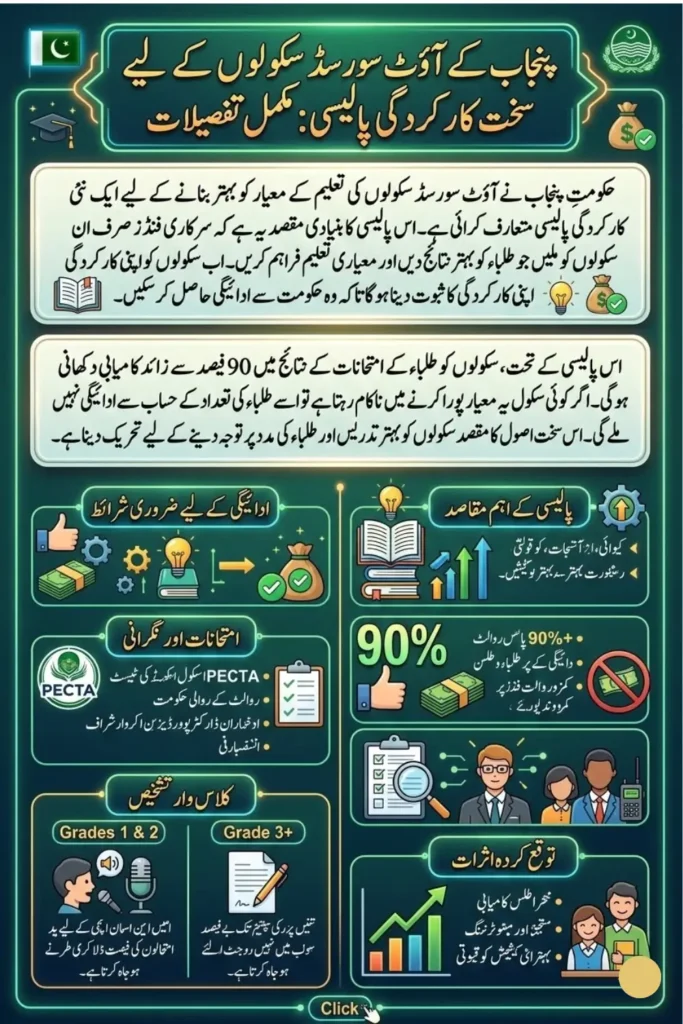
The Punjab government has launched a new Punjab outsourced schools performance policy to improve academic standards. The initiative connects students’ academic results with government payments to outsourced schools. Officials believe this system will encourage schools to focus more on learning outcomes and better teaching quality.
The Punjab Education Department explained that the policy aims to ensure that public funds support institutions delivering strong results. Schools must now show measurable academic performance to receive payments. Key goals of the policy include:
- Improving learning standards in outsourced schools
- Increasing accountability for government funding
- Encouraging better teaching practices
Pakistan Austerity Policy 2026: Salary Cuts, Budget Reductions and Travel Ban Approved by Government
Government Payments Linked with Student Results
Under the Punjab outsourced schools performance policy, school payments will depend on student examination results. Only schools achieving more than 90 percent pass results will receive payment for each student. Schools that fail to meet the required performance level may not receive government funds.
Officials say this rule will motivate schools to invest more effort in teaching and student support. Institutions will need to monitor learning progress closely and prepare students better for assessments. Key conditions of the payment policy include:
- Schools must achieve above 90 percent pass rate
- Payments will be given per student for qualifying schools
- Funds may be withheld from poorly performing schools
Pakistan 5G Spectrum Auction Start 2026: First Round Completed with Strong Telecom Bidding
PECTA Role in School-Based Testing
The Punjab Education Curriculum and Textbook Authority will conduct a special school-based test for outsourced schools. The results of these examinations will be submitted directly to the Punjab government. This testing process will provide an official record of academic performance.
The examination process will help the government compare school results across different districts. Authorities believe standardized testing will make performance evaluation fair and transparent. Main responsibilities in the testing process include:
- PECTA will design and conduct the examinations
- Results will be sent to the provincial government
- Schools must cooperate with the testing process
| Authority | Responsibility |
|---|---|
| PECTA | Conduct school-based tests |
| Punjab Education Department | Implement and monitor policy |
| Divisional Directors | Supervise exam process |
| Outsourced Schools | Prepare students for assessment |
Examination Supervision and Monitoring
Divisional directors and senior education officials will supervise the entire testing process. Their role is to ensure transparency and prevent irregularities during examinations. Strict monitoring will help maintain the credibility of the evaluation system.
PECTA will also cover the cost of printing exam papers for the tests. This step will standardize the assessment process across all outsourced schools. Important monitoring measures include:
- Supervision by divisional education authorities
- Official monitoring during examinations
- Centralized printing of exam papers by PECTA
Oral Assessment for Early Grade Students
Students in grades one and two will also be included in the evaluation process. However, their assessment will be conducted through oral examinations rather than written tests. This approach will measure early learning abilities such as speaking, reading, and basic understanding.
Education officials believe early assessment is important to improve foundational learning. By evaluating younger students, schools can identify weaknesses in teaching methods. Early grade evaluation will focus on:
- Oral tests for grades one and two
- Basic language and reading skills
- Early learning progress monitoring
Pakistan Government Work-From-Home Policy and Four-Day Work Week Amid Fuel Crisis
| Grade Level | Type of Assessment |
|---|---|
| Grade 1 | Oral examination |
| Grade 2 | Oral examination |
| Grade 3 and above | Written school-based test |
Expected Impact on Education Quality
The Punjab outsourced schools performance policy is expected to improve overall education quality. Linking payments with results will create stronger accountability among schools. Institutions will likely focus more on teaching quality and student preparation.
Students may benefit from better classroom support and improved learning resources. Teachers will also need to maintain higher academic standards. Expected outcomes of the policy include:
- Higher student pass rates
- Stronger monitoring of school performance
- Improved teaching quality in outsourced schools
Conclusion
The Punjab government’s new performance policy marks an important step toward improving school accountability. By connecting payments with student results, the government aims to ensure that education funding supports effective institutions.
The involvement of PECTA, divisional supervision, and standardized testing will strengthen transparency in evaluations. This policy is expected to motivate schools to deliver better academic outcomes for students across Punjab.
FAQs
What is the Punjab outsourced schools performance policy?
It is a government initiative linking school payments with students’ academic results.
What pass percentage is required for schools to receive payment?
Schools must achieve more than 90 percent pass results to receive payments per student.
Who will conduct the examinations for outsourced schools?
PECTA will conduct the special school-based tests and send results to the government.
How will students in grades one and two be assessed?
They will take oral examinations to measure early learning and communication skills.
What is the main goal of the new policy?
The goal is to improve education quality and ensure accountability in outsourced schools.