
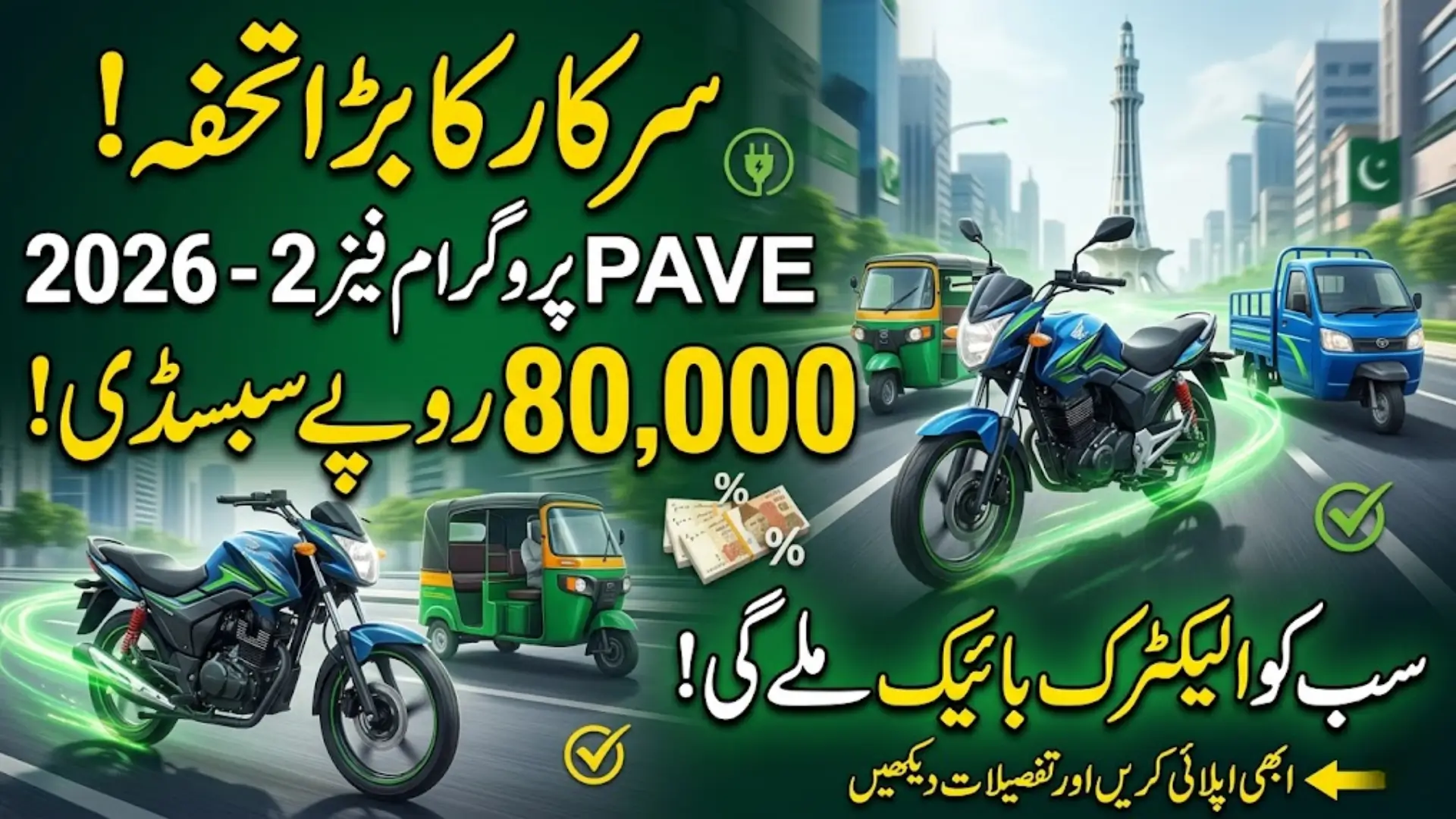
Pakistan PAVE Program Phase 2 2026
The Pakistan Accelerated Vehicle Electrification (PAVE) Program Phase 2 2026 is a major government initiative under the New Energy Vehicle (NEV) Policy 2025–30. It focuses on promoting electric bikes, rickshaws, and loaders across Pakistan. The aim is to reduce fuel consumption and support clean transportation.
- Focus on electric bikes, rickshaws, and loaders
- Subsidy-based EV adoption model
- Funded under NEV Policy 2025–30
- Designed for fuel savings and clean transport
This phase builds on the first pilot phase and introduces a faster, more transparent distribution system. The program is supported through a subsidy model funded by the NEV Adoption Levy Act 2025. It is designed to make electric mobility affordable for the public.
Pakistan Auto Policy 2026–31: New Tariff Cuts, EV Incentives, and Car Prices Impact Explained
Approval and Funding Structure of PAVE Program Phase 2 2026
The second phase has been approved by the Economic Coordination Committee (ECC) of the federal cabinet. A total allocation of Rs. 9.0 billion has been approved for FY2025–26. This funding supports large-scale distribution of electric vehicles.
- Approved by ECC of Pakistan
- Rs. 9.0 billion budget allocated
- Funded through NEV Adoption Levy Act 2025
- Revenue-neutral government model
The program follows a revenue-neutral model. It is financed through a levy on petrol and diesel consumption. This ensures continuous funding without creating extra budget pressure.
Vehicle Distribution Targets in PAVE Program Phase 2 2026
The government has set a large distribution target under this phase. The total goal is 119,170 electric vehicles for the current fiscal year. This includes bikes, rickshaws, and loaders.
- 116,000 electric bikes target
- 3,170 rickshaws and loaders included
- Revised Phase 2: 76,000 bikes + 2,170 rickshaws
- Extra fast-track plan: 100,000 bikes
After the pilot phase, the revised target focuses on faster rollout. A fast-track plan for additional electric bikes is also being prepared to speed up adoption.
Table: Vehicle Targets Under PAVE Program Phase 2
| Category | Target Units |
|---|---|
| Electric Bikes | 116,000 |
| Rickshaws/Loaders | 3,170 |
| Revised Phase 2 Bikes | 76,000 |
| Fast-track Bikes | 100,000 |
Subsidy Structure and Financial Model
The program provides a fixed subsidy for electric bikes to make them affordable. Each electric bike receives a subsidy of Rs. 80,000. This amount is directly paid to approved manufacturers after verification.
- Rs. 80,000 subsidy per electric bike
- Payment made to manufacturers (OEMs)
- Net price paid by buyers
- Verification-based subsidy release
Buyers do not receive cash directly. Instead, they pay the reduced price after subsidy deduction. This system ensures transparency and reduces misuse.
First-Come, First-Served Distribution System
The distribution method has been updated for Phase 2. The earlier balloting system has been replaced due to delays. Now, a first-come, first-served model is used.
- Balloting system removed
- First-come, first-served method introduced
- Faster and more transparent process
- Priority for Phase 1 waitlisted users
This change improves transparency and speeds up delivery. Priority is given to applicants based on exact submission time.
Phase 1 Performance and Lessons Learned
The first phase received very high public response. More than 269,000 applications were submitted for only 41,000 vehicles. This showed strong demand for electric mobility.
- 269,149 total applications in Phase 1
- 41,000 vehicles allocated
- Weak bank participation observed
- 99%+ success in self-finance delivery
However, bank financing delays slowed down the process. Self-finance cases performed better compared to bank-lease cases.
Financing Models and Payment Options
The program offers multiple financing options to increase access. These include bank leasing, self-finance, and payroll-based schemes. The goal is to reduce financial barriers.
Government employees also receive special support. Manufacturers deliver vehicles with minimal upfront payment in some cases.
- Bank-lease financing model
- Self-finance option for buyers
- Payroll deduction for government staff
- Support for NBFCs and fleet operators
Table: Financing Options Overview
| Model | Key Feature |
|---|---|
| Bank Lease | Loan-based approval system |
| Self-Finance | Buyer pays reduced upfront cost |
| Govt Payroll | Installments via salary deduction |
Special Incentives for Students and Government Employees
The program also includes social welfare elements. Around 600 electric bikes will be given free to top-performing students from HSSC exams across Pakistan.
- 600 free bikes for top students
- Rs. 10,000 down payment for employees
- Interest-free installment plans
- Focus on affordability and inclusion
Government employees in lower grades also benefit from low down payments and interest-free installments. This increases accessibility for middle-income groups.
Fuel Savings and Environmental Impact
The program is expected to reduce fuel consumption significantly. Early estimates show millions of litres of petrol savings in the short term. This also reduces import costs for fuel.
- 8.6 million litres petrol saving (short term)
- $222 million savings over 5 years
- Reduced carbon emissions
- Cleaner transport system
Over time, the environmental impact will be stronger. Reduced emissions support cleaner urban transport systems.
Implementation Strategy and Monitoring System
A dedicated 14-member unit has been established for implementation. This team manages distribution, verification, and monitoring of the program. It ensures smooth execution.
- 14-member EDB implementation unit
- Digital verification system
- Batch-based distribution model
- Strong monitoring and accountability
A digital tracking system is also used. It includes biometric verification and application monitoring for transparency.
Punjab Matric Registration Fee Increase 2026: Complete Details for Class 9 and 10 Students
Final Words
The Pakistan PAVE Program Phase 2 2026 is a major step toward electric mobility in the country. It focuses on affordability, transparency, and large-scale adoption of electric vehicles.
With strong subsidies, better financing options, and improved distribution systems, the program is expected to transform urban transport. It also supports environmental goals and fuel savings.
- Major EV adoption initiative in Pakistan
- Focus on affordability and clean energy
- Improved distribution and subsidy system
- Long-term environmental and economic benefits
FAQs
What is Pakistan PAVE Program Phase 2 2026?
It is a government EV subsidy program for electric bikes, rickshaws, and loaders.
It aims to promote clean and affordable transport in Pakistan.
How much subsidy is given per electric bike?
Each electric bike receives Rs. 80,000 subsidy.
The amount is paid directly to manufacturers.
What is the total target of this program?
The total target is 119,170 electric vehicles.
It includes bikes, rickshaws, and loaders.
How are vehicles distributed in Phase 2?
Distribution is now first-come, first-served based on timestamps.
This improves transparency and speed.
Who can apply for the program?
General citizens, students, and government employees can apply.
Special quotas exist for different groups.
Khyber Pakhtunkhwa Digital Licence Management System Launched to Transform Driving Licence Process