

Pakistan National Highway Toll Rates 2026
The National Highway Authority (NHA) has announced new toll rates across Pakistan. These charges will apply to national highways and motorways. The revised rates come into effect from April 5, 2026.
The update aims to standardize toll collection. It also ensures proper revenue for maintenance and development. Travelers and transport operators are expected to follow the new structure.
- Effective from April 5, 2026
- Applies to national highways and motorways
- Standardizes toll collection
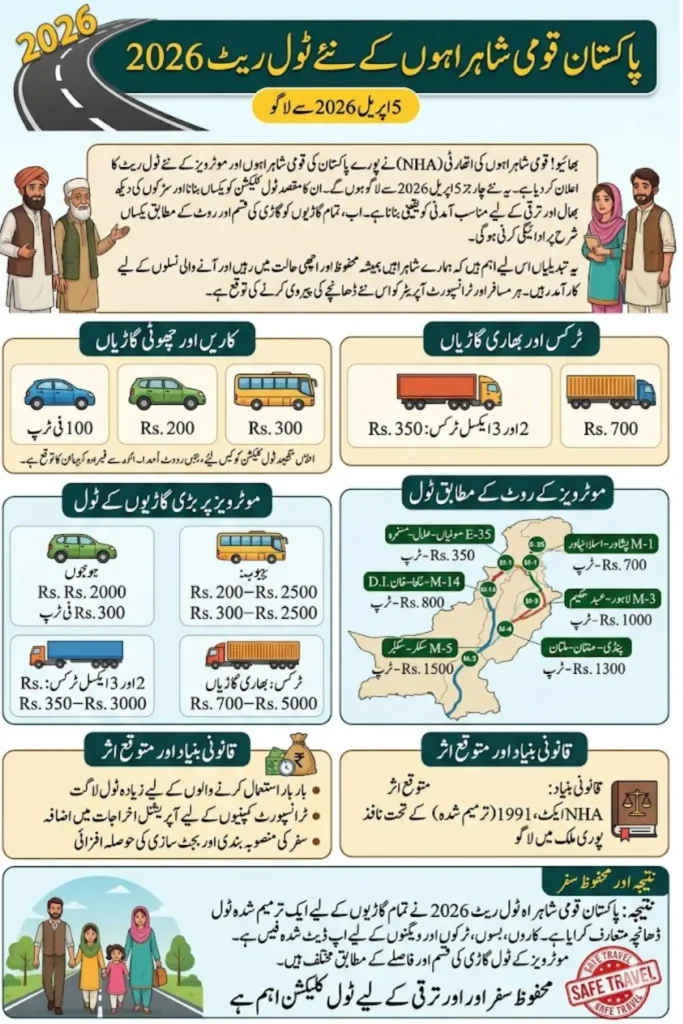
Toll Rates for Cars and Small Vehicles on National Highways
Cars on national highways will now pay Rs. 100 per trip. Wagons are charged Rs. 200, while buses will pay Rs. 300. These rates aim to keep charges fair for smaller vehicles.
The NHA has set higher fees for specific highways. For example, Kohat Tunnel (N-55) and Indus Motorway (E-75) have increased charges. The goal is to balance maintenance costs with traffic flow.
- Cars Rs. 100, wagons Rs. 200
- Buses Rs. 300
- Special routes have higher rates
Toll Charges for Trucks and Heavy Vehicles on National Highways
Two- and three-axle trucks will pay Rs. 350. Articulated trucks are now charged Rs. 700. These changes ensure that heavier vehicles contribute proportionally.
Highways with frequent heavy traffic may have slightly higher tolls. This supports road maintenance and safety improvements. Proper fees help sustain infrastructure quality.
- Two- and three-axle trucks Rs. 350
- Articulated trucks Rs. 700
- Higher tolls for busy highways
Sindh Emergency Services Modernization Plan: Rs30.8 Billion Approved for Unified Rescue System
Motorway Toll Rates by Route
Motorway tolls vary depending on the route. On the Islamabad-Peshawar Motorway (M-1), cars will pay Rs. 700. The Lahore-Abdul Hakeem Motorway (M-3) toll is Rs. 1000, and Pindi Bhattian-Multan (M-4) is Rs. 1300.
Other routes have specific rates to match distance and traffic. This ensures fair toll distribution. Drivers can plan trips and budgets accordingly.
- M-1 cars Rs. 700
- M-3 cars Rs. 1000
- M-4 cars Rs. 1300
Toll Rates on Other Motorways and Expressways
The Multan-Sukkur Motorway (M-5) has a car toll of Rs. 1500. On the D.I. Khan-Hakla Motorway (M-14), cars will pay Rs. 800. Hassanabdal-Havelian-Mansehra Expressway (E-35) charges Rs. 350.
These rates vary based on route length and construction costs. Larger vehicles face higher fees across these routes. The aim is to ensure proportional charges.
- M-5 cars Rs. 1500
- M-14 cars Rs. 800
- E-35 cars Rs. 350
Toll Charges for Larger Vehicles on Motorways
Wagons, buses, and multi-axle trucks pay higher rates. Toll fees vary by vehicle type and route. Heavy vehicles now contribute more to road upkeep.
This ensures maintenance of long-distance motorways. Proper toll collection helps manage traffic and infrastructure quality.
| Vehicle Type | Toll Rates (Selected Routes) |
|---|---|
| Cars | Rs. 100 – Rs. 1500 |
| Wagons | Rs. 200 – Rs. 2000 |
| Buses | Rs. 300 – Rs. 2500 |
| Two/Three-Axle Trucks | Rs. 350 – Rs. 3000 |
| Articulated Trucks | Rs. 700 – Rs. 5000 |
- Higher fees for larger vehicles
- Fees vary by route
- Supports road maintenance
Legal Basis for Revised Toll Structure
The revised tolls are set under the NHA Act, 1991 (amended). The law allows the NHA to adjust fees nationwide. All highways and motorways must follow the updated structure.
The legal framework ensures transparency and uniformity. It also allows the authority to maintain and expand road infrastructure effectively.
- Implemented under NHA Act, 1991
- Nationwide applicability
- Supports maintenance and development
Expected Impact on Travelers and Transport Sector
Travelers will experience higher toll costs on certain routes. Frequent highway users must account for the increase. Transport companies may face higher operational expenses.
The new toll system encourages planning and budgeting. Long-distance logistics will now include toll costs in operational planning. This ensures smoother financial management for businesses and drivers.
- Higher tolls for frequent users
- Increased operational costs for transport
- Encourages trip planning and budgeting
Conclusion
Pakistan National Highway Toll Rates 2026 introduce a revised toll structure for all vehicles. Cars, buses, trucks, and wagons have updated fees. Motorway tolls vary by route and distance.
The system aims to balance road maintenance costs with fair collection. Travelers and transport operators should plan for the new charges. Proper implementation will ensure safe and efficient travel nationwide.
FAQs
What are the new toll rates on Pakistan national highways?
Cars Rs. 100, wagons Rs. 200, buses Rs. 300, two- and three-axle trucks Rs. 350, articulated trucks Rs. 700.
When will the revised toll rates take effect?
The new rates will be effective from April 5, 2026, nationwide.
Do motorway tolls vary by route?
Yes, tolls depend on the motorway route. Examples include M-1 Rs. 700 and M-5 Rs. 1500 for cars.
Why were the toll rates revised?
To standardize fees, support road maintenance, and ensure fair contributions from all vehicle types.