
Punjab Free Urban Bus Service
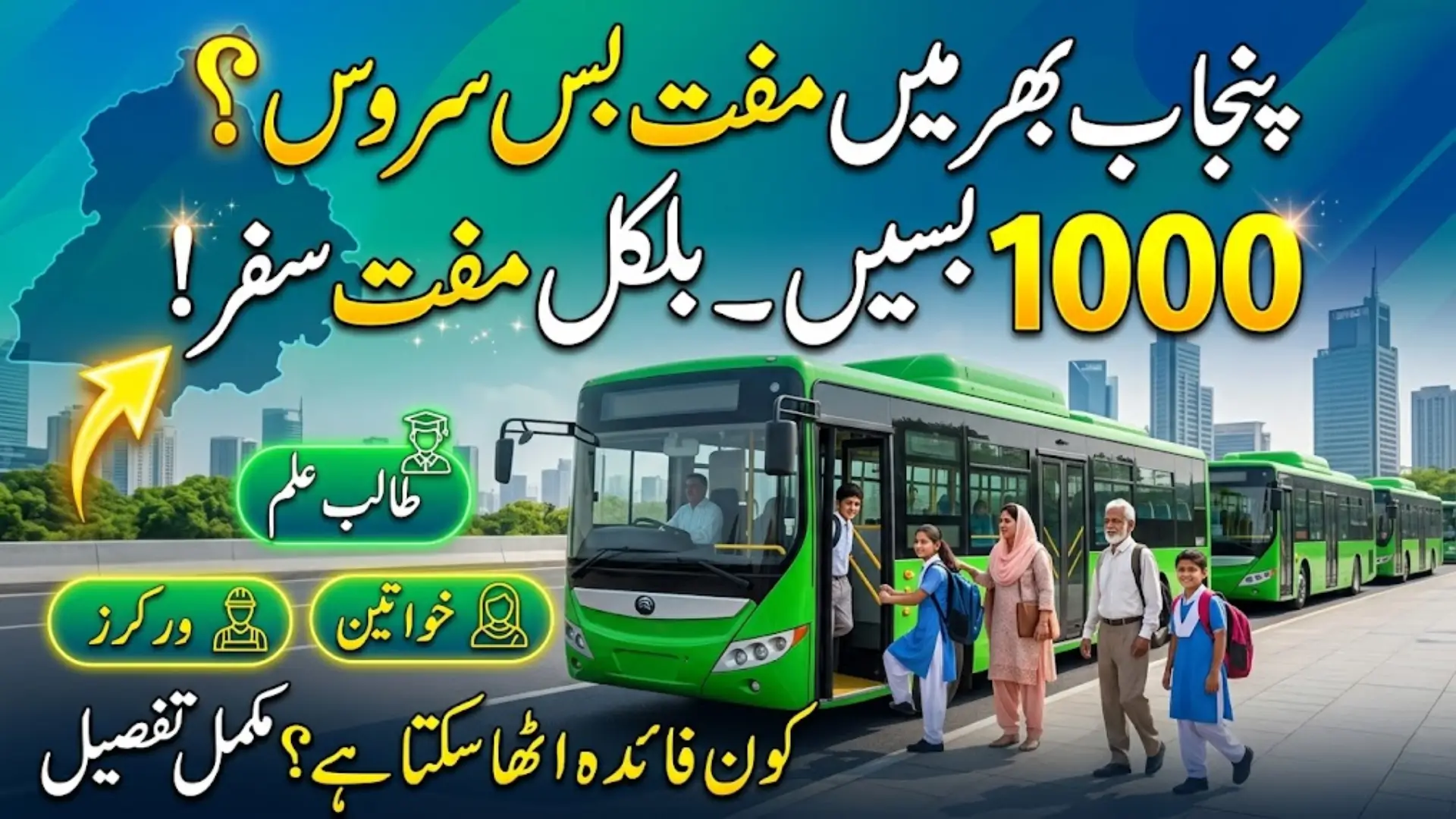
The Punjab government has taken a major step toward solving the public transport crisis in the province. A detailed plan for a Punjab free urban bus service has been prepared and approved at the highest level. Chief Minister Maryam Nawaz chaired the key meeting where this decision was made. The service will target districts that currently have no proper public transport facilities.
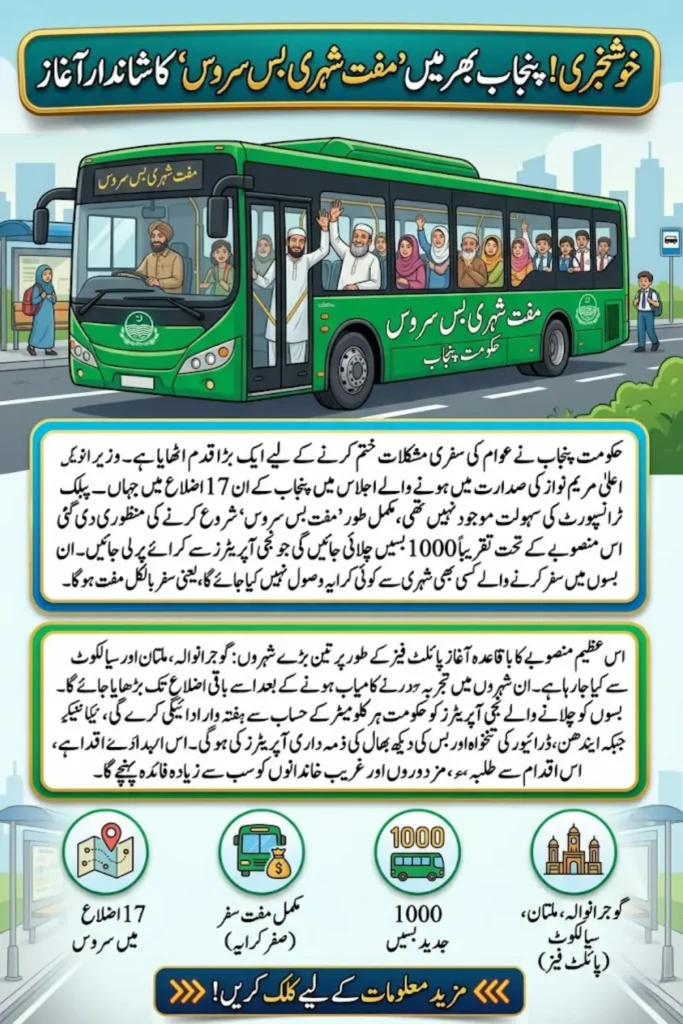
Under this initiative, around 1,000 buses will be operated through private operators on a rental basis. No fares will be charged from passengers. The service will be completely free for all citizens of Punjab. This article covers every important detail of the Punjab free urban bus service plan that citizens need to know.
8th Class Result Punjab Board 2026 Date, Time, How to Check Online and Board-Wise Details
Punjab Free Urban Bus Service – Background and Decision
The decision to launch the Punjab free urban bus service came directly from a meeting chaired by Chief Minister Maryam Nawaz. The meeting identified a serious gap in public transport across several districts of the province. Many citizens in these areas travel long distances daily without any reliable or affordable transport option. The government decided to address this gap with a structured and scalable plan.
Seventeen districts were identified as priority areas for the free bus service. These are districts where no formal public transport system currently exists. The government’s decision reflects a commitment to improving daily life for working-class citizens and students. The plan is designed to be practical, performance-based, and financially structured through a private operator model.
- Meeting chaired by Chief Minister Maryam Nawaz
- 17 districts identified with no existing public transport
- Plan designed to provide free transport to daily commuters
- Private operator model chosen for efficiency and accountability
- Decision reflects government focus on working-class citizens
Pilot Phase of Punjab Free Urban Bus Service in Three Cities
Before the full provincial rollout, the government has approved a pilot phase for the Punjab free urban bus service. Three cities have been selected for this initial phase: Gujranwala, Multan, and Sialkot. These cities represent different regions of Punjab and will help test the model in diverse urban environments. The pilot will allow authorities to identify operational challenges before scaling up.
The pilot phase is a smart approach to launching a large public service programme. Results from Gujranwala, Multan, and Sialkot will guide route planning, bus allocation, and operator management for the wider rollout. Citizens in these three cities will be among the first to benefit from the completely free urban bus service. The pilot’s success will determine how quickly the service expands to all 17 districts.
- Pilot phase approved before full provincial launch
- Three pilot cities: Gujranwala, Multan, and Sialkot
- Cities chosen from different regions of Punjab
- Pilot will test route planning and operator performance
- Results will shape the wider rollout across 17 districts
The table below provides a complete overview of the Punjab free urban bus service plan:
| Detail | Information |
| Initiative | Punjab Free Urban Bus Service |
| Decision Authority | Chief Minister Maryam Nawaz |
| Target Districts | 17 Districts with no public transport |
| Pilot Phase Cities | Gujranwala, Multan, Sialkot |
| Total Buses Planned | Around 1,000 buses |
| Operator Type | Private operators on rental basis |
| Payment System | Per-kilometer, performance-linked |
| Daily km Requirement | Minimum 100 km, Maximum 200 km |
| Passenger Fare | Completely free for all citizens |
| Operational Costs | Borne by private operators |
| Government Payment | Full weekly payments to operators |
How the Rental Model Works for Punjab Free Urban Bus Service
The Punjab free urban bus service will operate through a performance-linked rental model. Private operators will be hired and paid on a per-kilometer basis. This means the more kilometers a bus covers within the set limit, the higher the payment for the operator. This system encourages operators to maintain regular and reliable service on their assigned routes.
Each bus is required to operate a minimum of 100 kilometers daily. The upper limit is set at 200 kilometers per day. No payment will be made for any travel beyond the 200-kilometer daily cap. This structure ensures that buses stay on their routes and serve passengers efficiently without over-extending operations. The model keeps both the government and operators accountable under a clear set of rules.
- Operators paid on a per-kilometer performance basis
- Minimum daily requirement: 100 kilometers per bus
- Maximum daily limit: 200 kilometers per bus
- No payment made for travel beyond the 200 km cap
- System ensures route discipline and service reliability
- Weekly payments made by government to all operators
Hyundai Elantra 2.0 and Sonata 2.5 Installment Plans in Pakistan Complete Payment Guide
Route Planning and Passenger Demand for the Bus Service
Route planning for the Punjab free urban bus service will be based on actual passenger demand in each area. Authorities will study transport needs and commuter patterns before finalizing any route. This demand-driven approach ensures that buses run where they are needed most. Routes will be practical and cover the highest footfall areas in each district.
Each district may have different transport needs based on population density and geography. Officials will assess local requirements and finalize routes accordingly before the service begins. The flexibility of the route planning process allows adjustments to be made as ridership data becomes available. Citizens in underserved areas will benefit most from this structured and needs-based approach.
- Routes finalized based on passenger demand data
- Transport needs of each district assessed individually
- High footfall areas given priority in route planning
- Routes can be adjusted based on actual ridership
- Underserved and remote areas given special consideration
Responsibilities of Private Operators Under the Punjab Bus Plan
Private operators selected for the Punjab free urban bus service will carry full responsibility for all operational costs. This includes salaries for drivers, fuel expenses, regular vehicle maintenance, and any other day-to-day costs. The government will not be involved in managing these operational expenses. Operators must ensure their buses are roadworthy, safe, and running on schedule every day.
In return for meeting these responsibilities, the government will make full weekly payments to operators. Payments will be based on the kilometers covered within the approved daily limits. This arrangement creates a clear division of responsibility between the government and private operators. It also reduces the administrative burden on the government while keeping service delivery in the hands of experienced transport operators.
- Operators cover all costs including drivers and fuel
- Maintenance and repair expenses are operator responsibility
- Government does not manage day-to-day operations
- Full weekly payments made to operators by the government
- Payment calculated based on kilometers covered daily
- Operators must keep buses safe and on schedule
Citizen Relationship Management Punjab Sign Up, Online Apply and Government Portal Guide
The following table clearly shows the division of responsibilities between the government and private operators:
| Responsibility | Government | Private Operator |
| Weekly Payments | Full payment to operators | Receives payment |
| Driver Salaries | Not responsible | Fully responsible |
| Fuel Costs | Not responsible | Fully responsible |
| Vehicle Maintenance | Not responsible | Fully responsible |
| Route Finalization | Government decides routes | Follows assigned routes |
| Passenger Fares | Ensures zero fare policy | Cannot charge passengers |
| Daily km Monitoring | Monitors performance | Must meet 100-200 km daily |
Scale of the Punjab Free Urban Bus Service – 1,000 Buses
The Punjab free urban bus service is planned at a significant scale with around 1,000 buses to be deployed across the province. This large fleet is necessary to serve 17 districts effectively and provide meaningful coverage to daily commuters. A smaller fleet would not be enough to meet the transport needs of such a wide geographic area. The 1,000-bus target reflects the government’s serious commitment to this initiative.
The scale of this programme also creates opportunities for private transport operators across Punjab. Multiple operators will be engaged to manage different routes and districts. This distributed model reduces the risk of service failure and ensures that one operator’s issues do not affect the entire network. For citizens, a fleet of 1,000 buses means more frequent service and shorter waiting times at stops.
- Around 1,000 buses planned under the rental model
- Fleet size designed to serve all 17 target districts
- Multiple private operators engaged across different routes
- Distributed model reduces risk of system-wide failures
- Large fleet ensures frequent service and shorter wait times
- Scale reflects government’s long-term commitment to free transport
Zero Fare Policy – Punjab Free Urban Bus Service Is Completely Free
The most important feature of the Punjab free urban bus service is its zero fare policy. No passenger will be charged any amount to use the service. This applies to all citizens regardless of age, income, or travel distance. The government will fully fund the service through weekly payments to private operators, removing the cost burden from passengers entirely.
A free transport system has wide-ranging benefits for citizens. Students, daily wage workers, women, and elderly residents will all gain access to reliable urban transport without any financial barrier. This policy directly supports economic mobility and reduces household transport costs for low-income families. It is one of the most citizen-friendly transport decisions made in Punjab in recent years.
- Zero fare policy for all passengers on all routes
- Students and workers benefit most from free transport
- Women and elderly residents gain safer daily travel options
- Reduces household transport expenses for low-income families
- Government funds the service fully through operator payments
- No hidden charges or conditions for using the service
BISP 8171 Registration Step 2026 Guide For First Time Applicants
Frequently Asked Questions
What is the Punjab free urban bus service?
It is a government initiative to provide completely free public bus transport across 17 districts of Punjab. The service will be operated through private operators on a performance-linked rental basis.
Which districts will receive the Punjab free urban bus service?
The service targets 17 districts in Punjab that currently have no public transport facilities. Specific district names will be finalized as route planning is completed by the authorities.
Which cities are part of the pilot phase for the free bus service?
Gujranwala, Multan, and Sialkot have been approved for the pilot phase of the Punjab free urban bus service. These cities were selected to test the model before a wider provincial rollout.
How will private operators be paid under this plan?
Operators will be paid on a per-kilometer basis under a performance-linked system. The government will make full weekly payments for buses that cover between 100 and 200 kilometers daily.
How many buses will operate under the Punjab free urban bus service?
Around 1,000 buses are planned to be deployed under the rental model. These buses will cover routes across all 17 target districts based on passenger demand.
Will passengers be charged any fare for using the service?
No, the service is completely free for all citizens. No fares will be charged from any passenger under the Punjab free urban bus service plan.
Key Takeaways from the Punjab Free Urban Bus Service Plan
The Punjab free urban bus service is a well-structured and ambitious public transport initiative. It targets 17 districts where no transport currently exists and begins with a pilot in Gujranwala, Multan, and Sialkot. The rental model keeps operators accountable while the government handles weekly payments. Around 1,000 buses will cover routes based on real passenger demand across the province.
Citizens across Punjab stand to gain significantly from this zero fare transport system. Students, workers, and low-income families will no longer face the daily burden of transport costs. The performance-linked payment system ensures service quality stays high. The Punjab free urban bus service represents a meaningful step toward accessible, transparent, and people-centered public transport in Punjab.
Register Online for the Himmat Card: Verify Your Eligibility for the 10,500 Stipend Today!