

Ehsaas Program 8171
Introduction
The Ehsaas Program 8171 is a flagship initiative of the Government of Pakistan aimed at providing financial support to low-income and vulnerable families. In 2026, the program continues to play a vital role in reducing poverty, empowering women, and supporting households in meeting their basic needs. The initiative allows families to check their eligibility for financial assistance under the Benazir Income Support Programme (BISP) and register online for payments. By streamlining the registration process and making eligibility verification accessible through digital platforms, the program ensures that help reaches those who need it the most.
You Can Also Read:CM Punjab E-Bike Scheme 2026 –
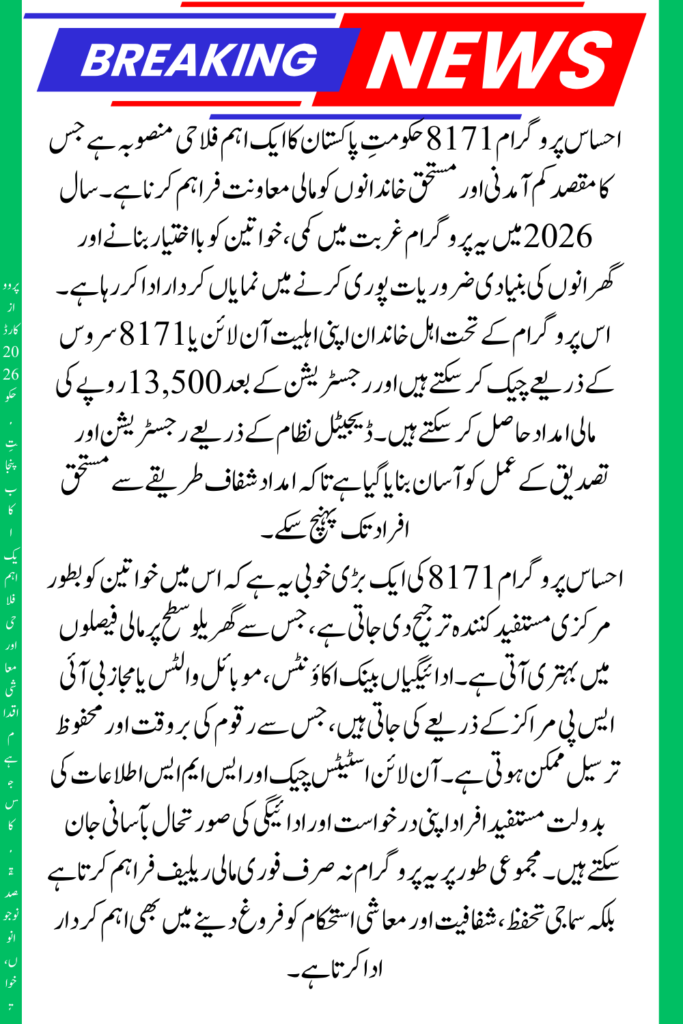
With growing economic challenges, many families rely on social welfare programs like Ehsaas 8171 to manage household expenses, cover healthcare costs, and provide educational support for their children. Understanding how to check eligibility, register online, and receive payments is essential for both applicants and policymakers. This essay explores the process of eligibility verification, online registration, payment procedures, and frequently asked questions about the Ehsaas Program 8171 in 2026.
Overview of Ehsaas Program 8171
The Ehsaas Program 8171 is part of a broader social protection framework under BISP that targets financially vulnerable families across Pakistan. Each eligible family receives a fixed cash payment to help cover essential needs. The program emphasizes women as primary recipients, acknowledging their critical role in household management and financial decision-making.
In 2026, the government announced payments of Rs. 13,500 for eligible families under the program. These funds provide temporary relief, improve family welfare, and help mitigate the impact of inflation on low-income households. The program is designed to be inclusive, transparent, and efficient, utilizing digital systems for registration, verification, and payment tracking.
How to Check Eligibility
Eligibility for the Ehsaas Program 8171 is determined based on several factors, including household income, family composition, and existing assistance from other government programs. Applicants can check their eligibility online through the official BISP portal or by contacting helpline services. The online eligibility check involves the following steps:
- Visit the official BISP website or use the designated mobile platform.
- Enter the CNIC number of the applicant to access family records.
- The system cross-checks the CNIC with government databases to verify income level and previous registrations.
- Eligible families are notified about their status and provided instructions for online registration.
By offering a straightforward eligibility check, the program saves applicants time and ensures that only deserving families receive financial assistance. Families are encouraged to update their CNIC and household information before checking eligibility to avoid delays or errors.
Online Registration Process
The online registration process for Ehsaas Program 8171 allows applicants to register for payments without visiting government offices. This digital approach increases accessibility, particularly for families in remote or underserved areas. The registration process involves the following steps:
- Access the official BISP or Ehsaas registration portal.
- Fill in personal information accurately, including CNIC number, name, and contact details.
- Provide details about household members and income if required.
- Submit the registration form and receive a confirmation number for reference.
- Monitor the application status through the portal or via SMS notifications.
Accurate and complete registration is crucial, as incorrect information may result in delayed approval or rejection. The online system also includes support services such as chat help, FAQs, and helplines to assist applicants in completing their registration successfully.
Payment Process and Updates
Once a family’s registration is approved, the payment of Rs. 13,500 is disbursed through secure channels. The program utilizes multiple methods to ensure that funds reach beneficiaries promptly:
- Partner banks where eligible families have accounts.
- Mobile wallets linked to the CNIC for quick access.
- Authorized BISP payment centers for families without bank accounts or digital access.
The system provides real-time updates regarding application status, verification, and payment disbursement. Beneficiaries can check whether their application is under review, approved, or if payments have been made. Notifications are typically sent via SMS, email, or portal alerts, allowing families to track payments without needing to visit physical offices.
You Can Also Read:Parwaz Card 2026 Registration –
Eligibility Criteria
To qualify for the Ehsaas Program 8171 in 2026, applicants must meet specific requirements:
- Families must be low-income or economically vulnerable
- The household should not already be receiving assistance from other similar government programs.
- Women are prioritized as primary recipients; however, exceptions are made in households without adult women.
- The applicant must possess a valid CNIC registered with NADRA.
- Families must reside in districts included in the current payment phase.
Meeting these criteria ensures that financial support reaches those who genuinely need it. Families are encouraged to keep their CNIC, contact information, and household records updated to facilitate smooth processing and payment disbursement.
Benefits of the Ehsaas Program
The Ehsaas Program 8171 provides several significant benefits to low-income families:
- Financial Relief: The payment of Rs. 13,500 helps cover essential expenses, including food, healthcare, and education.
- Women Empowerment: By directing funds to women, the program strengthens household decision-making and promotes gender equality.
- Accessibility: Online registration and CNIC verification make the program accessible to families in both urban and rural areas.
Transparency: Digital tracking systems reduce errors, fraud, and delays in payment distribution. - Social Development: The program contributes to broader poverty reduction efforts and supports the government’s social protection goals.
Through these benefits, the Ehsaas Program 8171 plays a crucial role in improving living standards and supporting vulnerable communities across Pakistan.
Frequently Asked Questions
What is the payment amount for Ehsaas Program 8171 in 2026?
Each eligible family receives Rs. 13,500 under the program.
How can I check if I am eligible for the program?
Eligibility can be verified online through the BISP portal or by contacting helpline services using the CNIC.
How do I register online for Ehsaas Program 8171?
Applicants can fill out the online registration form on the official portal, providing accurate personal and household information.
Which channels are used to disburse payments?
Payments are delivered via partner banks, mobile wallets, or authorized BISP payment centers, depending on the beneficiary’s registration.
What should I do if my registration is rejected?
Applicants should review the reason for rejection, update their CNIC or household information if necessary, and reapply or seek assistance from BISP support services.
You Can Also Read:BISP 8171 Registration 2026 – Step-
Conclusion
The Ehsaas Program 8171 in 2026 continues to provide vital financial support to low-income and vulnerable families across Pakistan. By enabling eligibility checks and online registration, the program has made it easier for households to access assistance without unnecessary delays or bureaucracy. Payments of Rs. 13,500 help cover essential household expenses, support women empowerment, and contribute to poverty reduction efforts nationwide.
Families seeking assistance must carefully follow the online registration process, ensure accurate CNIC verification, and monitor payment updates through official channels. The Ehsaas Program 8171 not only provides immediate financial relief but also strengthens social inclusion and long-term development for marginalized communities. By maintaining transparency, efficiency, and accessibility, the program plays a pivotal role in improving the welfare of Pakistan’s most vulnerable citizens.