

Punjab Child Marriage Restraint Bill 2026
Punjab’s Standing Committee on Local Government has unanimously passed the Punjab Child Marriage Restraint Bill 2026. The bill sets 18 years as the minimum legal marriage age for both boys and girls across the province.
NADRA New B-Form System Pakistan: Three-Stage Child Identification Process Explained
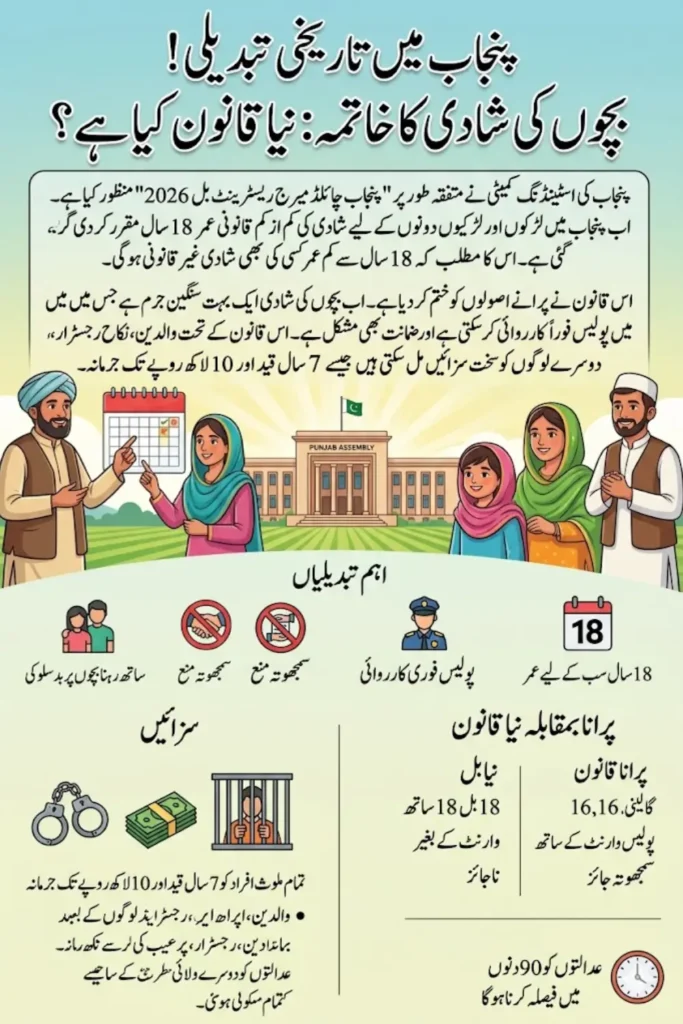
What Is the Punjab Child Marriage Restraint Bill 2026?
The Punjab Child Marriage Restraint Bill 2026 is a provincial law approved by the Standing Committee on Local Government and Community Development. It removes the earlier rule that allowed girls to marry at age 16. Now, no person under 18 can legally marry in Punjab.
The bill passed unanimously during a meeting held at the Punjab Assembly. MPA Muhammad Ashraf Rasool chaired the session. The provincial minister for local government and officials from relevant departments also attended.
Key Changes Introduced by the Bill
This bill brings major changes to Punjab’s marriage laws. It raises the minimum legal age for both boys and girls to 18 years. Earlier, girls could marry at 16 under the previous law, which is now removed.
- Minimum marriage age raised to 18 for both genders
- Previous provision allowing marriage at 16 for girls removed
- Child marriage declared a cognizable, non-bailable, and non-compoundable offence
- Police can now take immediate action without a court warrant
- Out-of-court settlements on child marriage cases are no longer allowed
Penalties Under the Punjab Child Marriage Restraint Bill 2026
The bill sets strict penalties for anyone involved in arranging or performing a child marriage. The law targets not just the adult spouse but also parents, guardians, Nikah registrars, and any other facilitators.
Courts are required to decide related cases within 90 days. This ensures faster justice for affected children and reduces delays in the legal process.
Chery Tiggo 7 PHEV Pakistan Launch: A Game-Changing Plug-In Hybrid SUV Enters the C-Segment
| Party Involved | Maximum Prison Sentence | Maximum Fine |
|---|---|---|
| Adult spouse | Up to 7 years | Rs. 1,000,000 |
| Parents or guardians | Up to 7 years | Rs. 1,000,000 |
| Nikah registrar | Up to 7 years | Rs. 1,000,000 |
| Other facilitators | Up to 7 years | Rs. 1,000,000 |
Cohabitation After Child Marriage Classified as Child Abuse
One of the strongest provisions in the bill is the classification of cohabitation after child marriage as child abuse. This carries stricter penalties than the basic marriage offence. The law recognises that the harm does not end at the marriage ceremony.
By labelling such cohabitation as child abuse, the bill gives courts stronger legal grounds to act. Children in such situations now have more direct legal protection under Punjab law.
Court Timeline and Draft Rules
The bill directs courts to resolve all related cases within 90 days. This prevents cases from dragging on for years, which often discourages victims from seeking justice in the first place.
- Courts must decide child marriage cases within 90 days
- Secretary of local government directed to finalise draft rules
- Draft rules must be presented within 60 days for committee approval
- Rules will guide implementation of the bill across Punjab
Comparison: Old Law vs New Bill
| Aspect | Previous Rule | Punjab Child Marriage Restraint Bill 2026 |
|---|---|---|
| Minimum age for girls | 16 years | 18 years |
| Minimum age for boys | 18 years | 18 years |
| Offence classification | Not cognizable | Cognizable, non-bailable, non-compoundable |
| Out-of-court settlement | Allowed | Not allowed |
| Cohabitation status | Not addressed | Classified as child abuse |
| Case resolution time | No fixed limit | 90 days |
Objectives of the Bill
The Standing Committee stated three main goals behind the Punjab Child Marriage Restraint Bill 2026. These are curbing child marriages, addressing gender disparity, and strengthening legal protections for children in Punjab.
- Reduce and eventually end child marriages across Punjab
- Close the gender gap in minimum marriage age (girls previously had a lower age limit)
- Provide stronger legal tools to protect children from forced early marriage
The bill reflects a shift in Punjab’s legislative approach toward child rights. It treats early marriage not just as a social issue but as a criminal offence with serious legal consequences.
Why This Bill Matters for Punjab
Child marriage harms children’s health, education, and future. Girls who marry early often leave school and face health risks from early pregnancy. Boys also face pressure to take on adult responsibilities too soon.
By making child marriage a non-bailable and non-compoundable offence, the Punjab government removes legal loopholes. No one can pay a fine and walk away. No one can settle the matter privately. The law now demands full accountability from all parties involved.
Frequently Asked Questions
What is the Punjab Child Marriage Restraint Bill 2026?
It is a bill passed by Punjab’s Standing Committee that sets 18 years as the minimum legal marriage age for both boys and girls. It replaces older rules and introduces strict criminal penalties for violators.
What was the previous minimum marriage age for girls in Punjab?
Under the earlier law, girls could legally marry at the age of 16. The new bill removes this provision and raises the age to 18, equal to that of boys.
What punishment does the bill prescribe for child marriage?
Anyone who facilitates child marriage, including parents, the adult spouse, or a Nikah registrar, can face up to 7 years in prison and a fine of up to Rs. 1 million.
Why is child marriage classified as a non-bailable offence?
Making it non-bailable means police can arrest the accused without granting immediate bail. This ensures serious action is taken and accused parties cannot easily avoid the legal process.
How soon must courts decide child marriage cases?
The bill directs courts to resolve all child marriage-related cases within 90 days. This ensures timely justice and prevents long delays that could discourage victims from pursuing legal action.
When will draft rules under the bill be finalised?
The committee directed the secretary of local government to prepare and present draft rules within 60 days. These rules will guide how the bill is implemented across Punjab.